
Table of Contents
- Defining IT Certification And Common Myths
- Types Of IT Certifications And Key Differences
- How IT Certification Exams Work
- Career Benefits And Real-World Value
- Costs, Pitfalls, And Choosing Wisely
Key Takeaways
| Point | Details | |
| IT Certifications Enhance Career Prospects | Certifications are increasingly valued by employers as they demonstrate up-to-date skills and can lead to higher salaries and promotions. | |
| Choose the Right Certification Path | Start with foundational certifications and strategically progress to advanced ones aligned with your career goals. | |
| Be Aware of Costs and Commitments | Budget for both exam fees and study materials, and avoid attempting multiple certifications simultaneously to increase success rates. | |
| Stay Relevant with Continuous Learning | Certifications require ongoing education, ensuring professionals remain competitive in their field and adaptable to industry changes. |
Defining IT Certification and Common Myths
An IT certification is a credential that proves you have specific technical skills and knowledge in your field. Think of it as a badge that tells employers, "I know what I'm doing in this area." Unlike degrees, which take years to complete, certifications focus on practical, job-relevant skills you can learn and test in months. They come in three main levels: foundational certifications for newcomers to the industry, professional certifications for those with some experience, and advanced certifications that demonstrate mastery in specialized areas like cloud architecture or network security.
What makes certifications valuable is that they're recognized globally and backed by industry standards. Major vendors like AWS, VMware, Oracle, and Palo Alto Networks develop these credentials to ensure they match real workplace demands. The vendor creates the exam, sets the standards, and recognizes people who pass. This means an AWS Certified Solutions Architect credential carries the same weight whether you earn it in Canada, Singapore, or Brazil. Organizations like BCS provide over 75 professional IT certifications aligned with industry frameworks, proving that these programs support IT professionals at every career stage while maintaining global recognition.
Now let's address the myths that hold people back. One persistent misconception is that certifications are only for beginners or career changers. In reality, experienced professionals use advanced certifications to stay competitive and move into leadership roles. Another myth claims certifications are outdated or less valuable than degrees. False. Many employers now prioritize certifications because they prove current skills, not knowledge from a classroom five years ago. Some people also believe certifications guarantee a job or immediate salary bump. They don't guarantee employment, but they significantly improve your chances and earning potential. According to IT certification roadmap research, certifications demonstrate your abilities to potential employers and support career advancement across different experience levels. The third misconception is that you need to choose between getting a degree or pursuing certifications. You don't. Many successful IT professionals have both, using certifications to fill gaps and stay current while their degree provides foundational knowledge.
Pro tip:
Types of IT Certifications and Key Differences
IT certifications aren't all created equal. They're organized into three distinct tiers, and knowing which one fits your career stage makes all the difference. Foundational certifications are your entry point into the field. They cover broad, basic IT skills and assume little to no prior experience. These are perfect if you're transitioning from another career or starting your first IT role. Professional certifications sit in the middle. They require some hands-on experience and dive deeper into specific domains like cloud computing, networking, or cybersecurity. Advanced certifications represent mastery. They're specialized, often tied to particular job roles or cutting-edge technologies, and they're what experienced professionals pursue to stay ahead of the curve. IT certification categories break down these levels clearly, showing how foundational credentials set the foundation while professional and advanced certifications build specialized expertise.
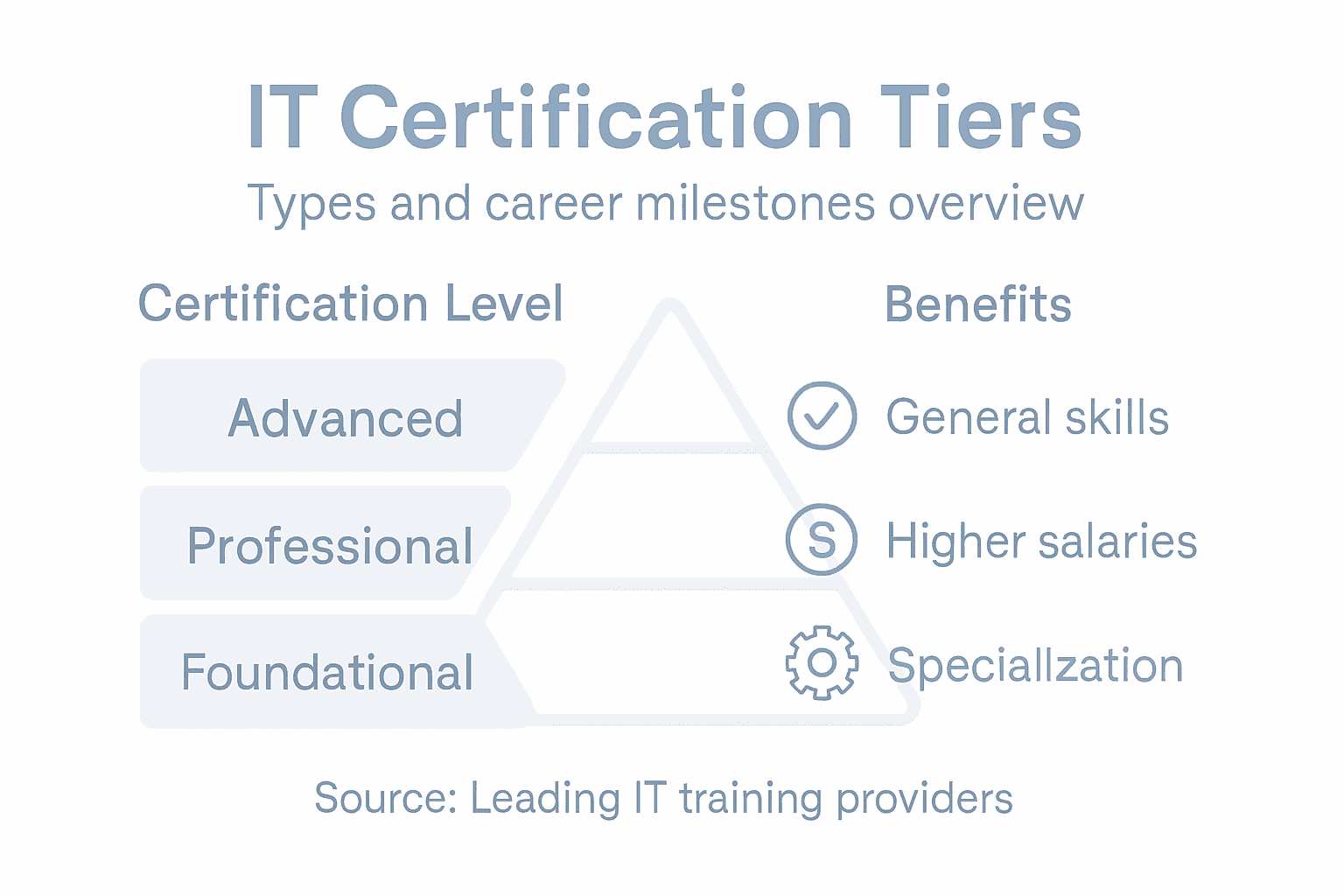
The key differences go beyond just difficulty level. Each tier targets a different audience and career milestone. Foundational certs might take 2 to 4 months to prepare for, while advanced certifications can demand 6 months to a year of study, especially if you're learning entirely new concepts. The cost also scales. Entry-level vouchers typically range from $100 to $150, whereas advanced specialty certifications can cost $200 to $300 or more at full price. That's why securing discounted vouchers before you start studying matters. Some certifications focus on vendor-specific knowledge, like AWS or VMware products. Others validate broad industry competencies across multiple vendors. Certifications ranging from foundation to expert levels are industry-aligned and globally recognized, covering diverse IT disciplines and catering to different professional goals and schedules.
Another critical difference is specialization. Foundational certifications give you general IT knowledge. Professional certifications let you specialize, such as focusing exclusively on cloud infrastructure, cybersecurity, or database administration. Advanced certifications narrow even further, targeting roles like Security Architect or Solutions Designer. Think about your target role, then work backward to choose the right certification path. A system administrator might start with a foundational cert, move to a cloud platform professional cert, then pursue an advanced cloud architect credential over three years. Someone pivoting to cybersecurity might take a different route entirely. The timeline, cost, and focus area all differ based on where you sit in your career and where you're heading.
Here's a summary of IT certification tiers and their key characteristics:
| Certification Tier | Target Audience | Typical Exam Duration | Common Costs |
| Foundational | Beginners, career changers | 1-2 hours | $100-$150 |
| Professional | Mid-level IT professionals | 2-3 hours | $200-$250 |
| Advanced | Experts, specialists | 4-6 hours | $300 or higher |
Pro tip:
How IT Certification Exams Work
IT certification exams aren't your typical multiple choice tests from high school. They're designed to validate that you can actually do the job, not just memorize facts. Most exams follow a standardized format delivered through testing centers or online proctoring platforms. You'll sit at a computer, answer questions under timed conditions, and receive a score immediately or within days. The format varies by certification and vendor. Some use pure multiple-choice questions, while others incorporate performance-based items where you solve real-world problems or scenario-based questions that test your decision-making skills. The CISA exam structure exemplifies this approach, consisting of 150 questions covering five domains related to information systems auditing and governance, testing both knowledge and practical application relevant to actual IT roles.
Exam difficulty scales with your certification level. Foundational exams typically have 50 to 100 questions and take 1 to 2 hours. Professional exams jump to 100 to 150 questions spanning 2 to 3 hours. Advanced exams can push 4 to 6 hours with complex scenario-based questions requiring deep technical knowledge. Some vendors use adaptive testing technology, which means the difficulty adjusts based on your answers. Answer a question correctly, and the next one gets harder. Miss one, and it might get easier. This keeps the test calibrated to your actual skill level. The Certified in Cybersecurity exam uses computerized adaptive testing with 100 to 125 questions completed over 2 hours, focusing on technical concepts and practical cybersecurity knowledge across domains like security principles, incident response, and access controls.
When you register for an exam, you book a testing appointment at an authorized center like Pearson VUE, Prometric, or through your vendor's online proctoring system. Most vendors allow you to test at your own pace on your schedule. You'll need to bring identification, show up early for check-in, and leave personal items outside the testing room. During the exam, you cannot access external materials, phones, or anything that looks like cheating. Proctored exams may include screen recording and webcam monitoring. After you finish, you typically get an instant pass or fail result, though some vendors send detailed score reports within 48 hours. Passing scores vary by exam. Some require 70 percent correct, others 75 or 80 percent. Always check your specific exam's passing score before test day.
Pro tip:
Career Benefits and Real-World Value
Let's talk about what actually matters: your paycheck and your career trajectory. IT certifications directly impact both. Studies show that certified IT professionals earn significantly more than their non-certified peers in the same roles. A systems administrator with a relevant certification might earn 15 to 25 percent more annually than one without it. For someone making $60,000, that's an extra $9,000 to $15,000 per year. Over a 20-year career, that compounds into hundreds of thousands of dollars. Beyond salary, certifications open doors to positions you couldn't access before. Employers actively seek certified professionals because certifications prove you know what you're doing. IT certifications lead to higher incomes and increased competitiveness in the job market, helping candidates stand out and facilitating specialization in high-demand areas like cybersecurity or cloud computing.

Job security is another massive benefit that often gets overlooked. Technology changes constantly, but certified professionals stay relevant because certifications force continuous learning. When your company needs someone to migrate to AWS or implement a new security framework, the certified person gets the call. You become the person others depend on. That makes you valuable and harder to replace during layoffs. Certifications also accelerate promotions. Instead of waiting five years to prove yourself, a certification gives you instant credibility. You can move from junior technician to mid-level specialist or team lead faster. Companies recognize that certified professionals require less training and can contribute immediately. The global demand for IT talent means your certification opens doors worldwide. If you're thinking about relocating or working remotely for an international company, a recognized certification removes barriers. Your credentials are valid in Canada, Australia, Germany, or Singapore.
There's also the confidence factor, which matters more than people realize. When you earn a certification, you've passed a rigorous exam that validates your skills. That confidence shows in your work, in interviews, and in how you handle challenging projects. You stop second-guessing yourself. You approach problems methodically because you've studied the right approaches. Employers notice. Pursuing IT careers offers diverse job roles and good earning potential with job security and continuous learning opportunities, while certifications enhance credibility and improve employment prospects globally. The real-world value is straightforward: certifications translate to better pay, faster advancement, stronger job security, and the freedom to choose where and how you work.
Pro tip:
Costs, Pitfalls, and Choosing Wisely
Here's where many people stumble: they underestimate the total cost of certification. The exam voucher is just the beginning. You need to factor in study materials, practice tests, training courses, and sometimes exam retakes. A single certification can easily cost $300 to $800 when you add everything up. Then there are hidden expenses. Annual maintenance fees. Continuing education requirements. Renewal exam fees. Certification costs include exam fees, application processing, and annual maintenance expenses, plus optional study materials and membership fees that candidates should budget for properly. This is why securing discounted exam vouchers matters so much. Buying a $200 voucher at full price versus $100 through a discount provider instantly cuts your spending in half. Over multiple certifications, those savings add up to thousands of dollars. Budget-conscious IT professionals should always hunt for discounted vouchers before registering for exams.
Now let's talk about the pitfalls that waste your money and time. The biggest mistake is chasing certifications randomly instead of following a strategic path. You see an interesting credential and jump into it without checking if it matches your career goals. Six months and $500 later, you realize it doesn't help your trajectory. Another common trap is attempting too many certifications simultaneously. You're already working full-time, and now you're studying for three exams at once. Your focus splits, your preparation suffers, and you fail. Failed exams waste money, time, and confidence. Proper planning requires understanding career goals, available time, and financial resources, with experts recommending against taking multiple certifications at once to reduce failure risk and wasted expenses. Start with foundational credentials, master them, then progress to advanced ones. This sequencing improves your success rate and return on investment.
Another pitfall is ignoring prerequisites. Some advanced certifications require previous experience or passing a foundational exam first. Attempting them without proper groundwork leads to failure. Then there's the sunk cost fallacy. You're struggling with a certification that doesn't match your interests or aptitudes. You already spent $400. Might as well finish, right? Wrong. If it's not the right fit, stop, reassess, and pivot to something better. Your time is more valuable than a sunk voucher cost. Finally, avoid chasing trendy certifications just because they're popular. AI certifications are hot right now, but if you're a network engineer, a cybersecurity or cloud certification makes more sense for your career. Choose based on what employers in your target market actually demand, not hype.
Below is a comparison of common IT certification pitfalls and tips for avoiding them:
| Common Pitfall | Impact | Prevention Strategy |
| Random credential chasing | Wasted money and time | Set clear career goals first |
| Taking multiple exams at once | Lower pass rates, burnout | Focus on one cert at a time |
| Ignoring prerequisites | Increased failure risk | Check requirements before registering |
| Following hype, not demand | Poor job prospects | Align with market/job postings |
Pro tip:
Unlock Your IT Career Potential with Affordable Certification Resources
Understanding the value of IT certification is the first step but overcoming the hurdles of high exam costs and finding reliable study materials is a challenge many face. Whether you are starting with foundational credentials or aiming for advanced specialist certifications, getting the right resources without breaking the bank is critical to staying competitive and advancing your career. Certifications prove you have the skills employers demand and open doors to higher salaries and better job security.
Take control of your certification journey today with CertShopServices. Save up to 50 percent on exam vouchers for top vendors like VMware, Oracle, AWS, Palo Alto Networks, and more. Our digital delivery means you get your vouchers quickly, ready for online or Pearson VUE test centers. Plus, find discounted study guides and practice exams to boost your confidence and exam readiness. Don’t wait until prices rise or your opportunity slips away. Visit CertShopServices now and start investing in your career success with affordable, trusted certification materials.
Frequently Asked Questions
What is an IT certification?
An IT certification is a credential that verifies a person's technical skills and knowledge in a specific area of information technology. It's a way for employers to assess a candidate's qualifications based on standardized examinations.
Why do IT certifications matter?
IT certifications are valuable because they demonstrate your competencies in relevant skills to potential employers. They are globally recognized and can significantly improve employment opportunities, earning potential, and career advancement.
How do IT certifications vary in difficulty?
IT certifications are categorized into three levels: foundational, professional, and advanced. Foundational certifications are for beginners, requiring less study and preparation time, while advanced certifications demand more in-depth knowledge and longer study periods.
Do IT certifications guarantee a job?
While IT certifications do not guarantee employment, they enhance your job prospects and can lead to higher salaries. They demonstrate to employers that you possess the skills necessary for the role, which can give you a competitive edge in the job market.